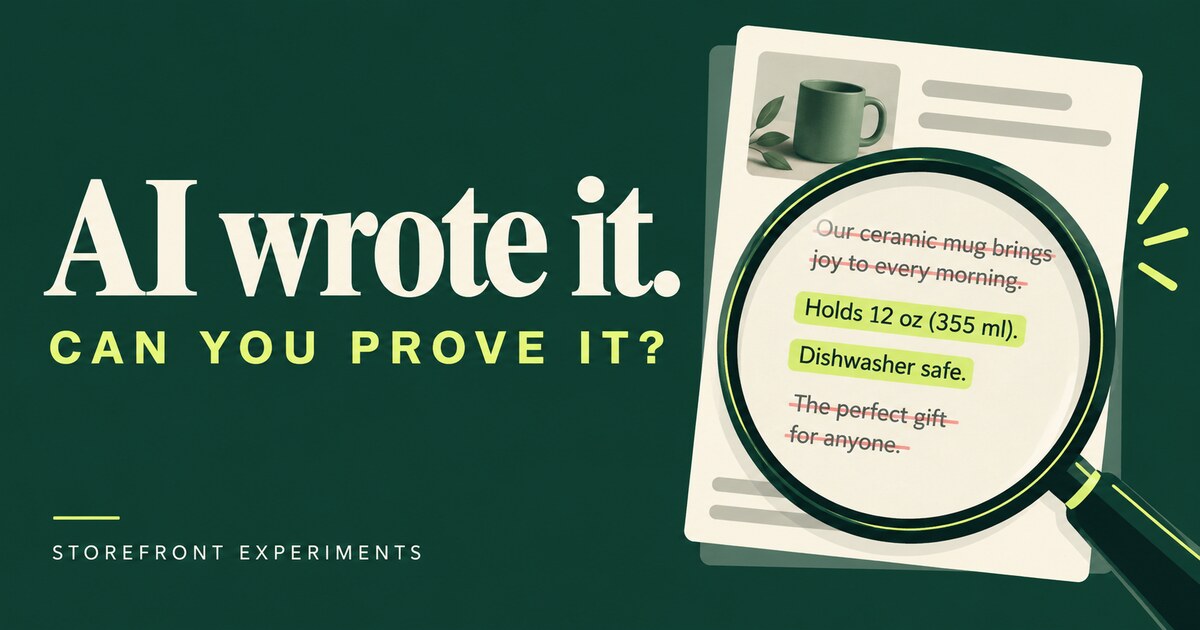
A polished product description can still leave a customer with the wrong impression. AI can make a sentence sound convincing without making it true. Before that sentence reaches your store, someone needs to check the evidence behind it.
At Storefront Experiments, we document the work of building ERVALO with AI. Our previous article explored whether a store feels trustworthy enough to buy from. This next step focuses on one small but important part of that trust: the words on a product page.
Here is a practical review workflow to make your next product description easier to verify.
Start with a product fact sheet
Before asking AI to write, gather the information you can actually confirm. Include the product name, materials, available sizes, colour, construction details, care instructions and any relevant fit information.
Keep unknowns visible. If you do not have a verified size chart or a confirmed performance claim, record that gap instead of asking AI to fill it with plausible wording.
For example, “high waist” may be a confirmed design detail. “Stays in place through every workout” is a much broader promise. The second statement needs evidence that the first does not provide.
The fact sheet gives you something concrete to compare the draft against. Without it, a review can become a check of whether the writing sounds good.
Give AI a boundary as well as a brief
Ask for clear, useful copy, then specify what the model may use. A simple prompt is enough:
Write a clear English product description using only the facts below. Do not invent benefits, certifications, test results, delivery promises or fit guarantees. List missing information separately from the customer-facing text. Use short paragraphs and a concise feature list.
Paste your verified fact sheet underneath. Treat the response as a draft, even when the language looks ready to publish.
The separate list of missing information is useful: it turns uncertainty into a task you can resolve instead of hiding it inside fluent copy.
Review claims one sentence at a time
Read each factual sentence and ask: what supports this?
- Materials: Does the composition match the product information?
- Fit: Are statements about sizing supported by measurements or fitting evidence?
- Performance: Do claims about support, moisture handling or durability have a reliable basis?
- Availability: Does the wording match the product's actual selling status?
- Delivery and returns: Does the copy agree with the store's current policies?
Delete or narrow unsupported claims. “Designed with a high waist” is more specific than “the perfect fit for every body.” A useful description tells customers what they can assess rather than promising a universal experience.
If a detail matters to the buying decision and remains unknown, investigate it before publishing the claim.
Check the page on a phone
Copy accuracy is only part of the review. Open the product page as a customer would and read it alongside the images, price, size selector and purchase controls.
Can you quickly tell what the item is? Is the most useful information easy to find? Does a feature list repeat the introduction without adding anything? Are care instructions or sizing details buried beneath several paragraphs of promotional language?
Shorten anything that delays an answer. Put product facts where a buyer is likely to need them. Keep links to delivery and returns information easy to recognise.
Read the text aloud, too. If a sentence would sound awkward when explaining the product to a person, simplify it.
Review each language separately
For a bilingual store such as ERVALO, the English page needs its own review. A translation can preserve the general idea while changing the strength of a claim or making a sizing instruction harder to understand.
Compare the two versions against the same fact sheet. Check product names, size labels, measurements and policy links. Make sure both versions answer the same customer questions.
Consistency is easier to maintain when the facts are recorded in one place, even if the final wording differs naturally between languages.
Keep a small correction log
Record the claim you changed, the reason and the information you still need. A short note such as “removed unsupported fit guarantee; waiting for verified measurements” is enough.
Use those corrections to improve the next brief. If AI repeatedly adds the same unsupported promise, explicitly exclude it from future prompts.
If you later measure time savings, count the whole job: preparing the facts, generating the draft, checking it, editing it and verifying the published page. Generation time alone does not tell you how long the work took.
Your next product-page check
Choose one description and highlight every factual claim. Match each one to a source, revise it or remove it. Then check the complete page on mobile and in each language you offer.
For a broader review, open our free ecommerce launch checklist. It helps you organise the questions to check before launch.
What is one claim you have removed from an AI-generated description? Share it in the comments. If this workflow helped, leave a like and subscribe to Storefront Experiments for the next build notes.
Leave a Reply